P0303

Combustion failure detected in cylinder 3.

The computer detected that cylinder 3 was not contributing power consistently. The code does not identify which component caused the condition.

What should be checked

01

Ignition system issue to investigate

The ignition energy may be insufficient or irregular in the affected cylinder.

In plain language: The mixture may not be receiving a strong and stable spark.

How to check it
Confirm the engine, inspect for visible damage first, and use the diagnostic sequence that applies to the vehicle. A professional can compare cylinder contribution, spark, and electrical control before condemning a part.
Before correcting it
If testing confirms the spark plug, coil, lead, or its circuit, correct only that fault and repeat the test under the same conditions. P0303 by itself does not justify replacement.
Related components
This path may involve the spark plug, an individual ignition coil or high-tension lead if the design uses one, and the cylinder 3 connector and wiring. None has been confirmed.
When to stop
Stop and ask for professional help if there is blinking light, fuel smell, strong vibration, smoke, heat or power loss.
02

Fuel delivery issue to investigate

The cylinder may receive a different amount of fuel than is necessary due to a supply or control problem.

In plain language: That cylinder may be getting too much or too little fuel.

How to check it
A professional should test fuel delivery, electrical control, and injector operation using the exact procedure. Pressurized lines should not be opened for a home inspection.
Before correcting it
If testing confirms a restriction, leak, or control fault, correct the circuit or injector identified by the test and verify again. The code alone is not a basis for recommending a part.
Related components
This path may involve the cylinder 3 fuel injector, its connector, wiring, or shared fuel-supply components. None has been confirmed.
When to stop
Don't open lines or handle fuel. Stop at intense smell, leak, smoke, fire or very unstable operation.

03

Intake, EGR, or airflow issue to investigate

Unmetered air or uneven EGR flow can alter the air-fuel mixture or combustion in one cylinder on some engines.

In plain language: On some engines, air may enter where it should not or the intake flow may be distributed unevenly. A vehicle-specific test is needed.

How to check it
Check for bulletins that apply to the vehicle and perform an inspection or leak test using an authorized method. Do not use smoke or pressure without training and the correct limits.
Before correcting it
The eventual repair may involve a connection, seal, hose, deposit buildup, or an intake/EGR component, but only after locating the fault and confirming that the information applies.
Related components
This path may involve a hose, connection, seal, intake gasket, passage, or EGR component applicable to the engine. None has been confirmed.
When to stop
Consult a professional if the test requires a smoke or pressure test, removing intake/EGR components, or if warning signs appear.

04

Compression or sealing issue to investigate

A compression or sealing difference can reduce the cylinder's input even if spark and fuel are present.

In plain language: The cylinder may not be closing or compressing just like the others.

How to check it
Comparative test of compression or leakage only with the manufacturer's method and limits or an authorised source.
Before correcting it
If a comparative test confirms a mechanical loss, determine the component and repair from the exact engine information. The code does not justify disassembling the cylinder head, valves, or engine.
Related components
This path may involve valves, valvetrain, a piston, rings, a cylinder, or a head gasket, depending on the test and engine. None has been confirmed.
When to stop
Go to a professional before dismantling the engine and immediately stop if there is smoke, heat or fluid loss.
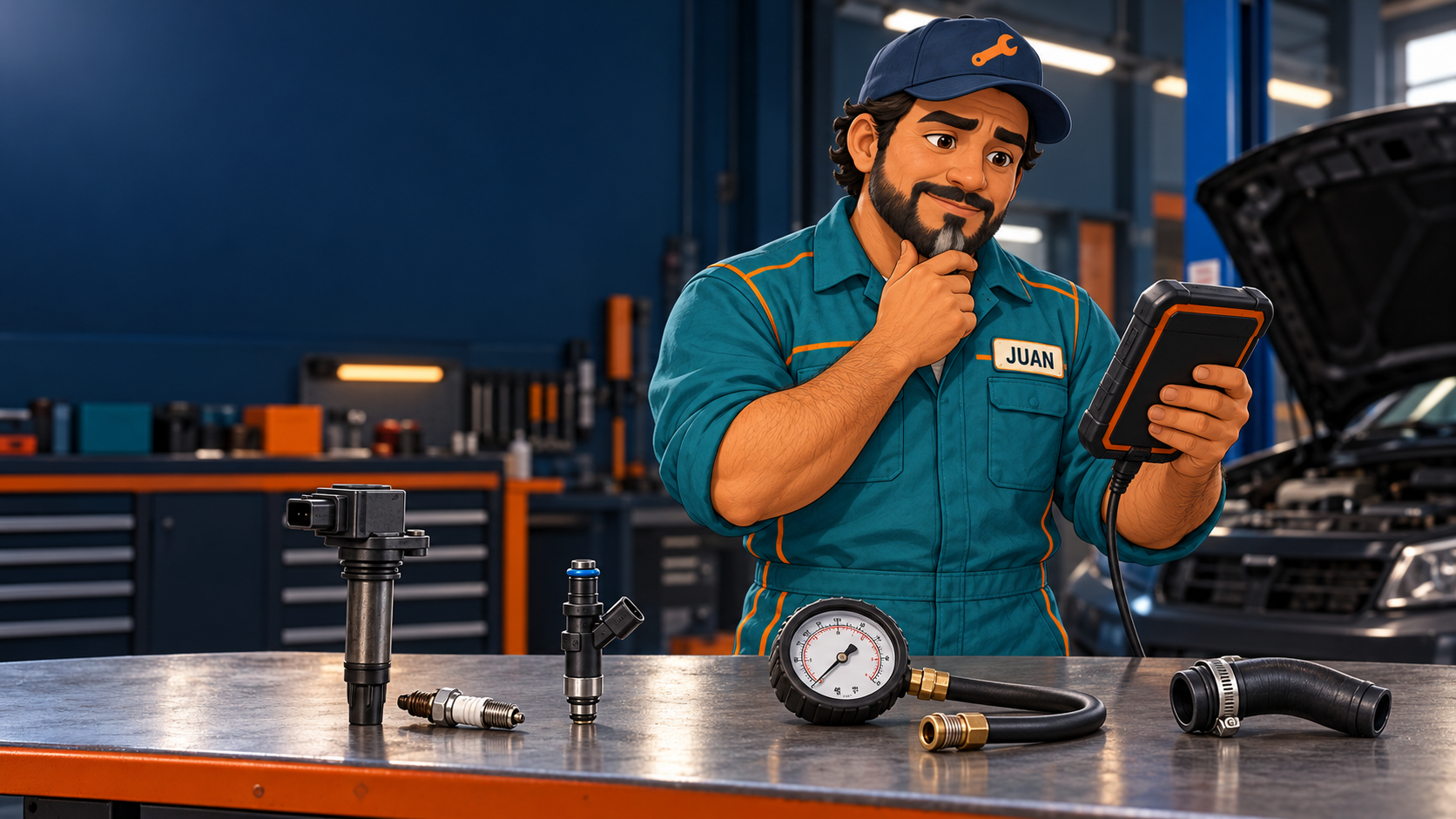
Juan el Mecánico reviews a scanner beside an ignition coil, spark plug, fuel injector, compression gauge, and hose.
Original editorial illustration. It shows component families related to the diagnosis; it does not identify the failed part or its location in a specific vehicle.
Conceptual P0303 map with four paths: ignition, fuel, air, and mechanical condition.
Original conceptual map. Cylinder arrangement, connections, and specifications vary by engine.

Information needed for a more precise diagnosis

  • Exact brand, model, year, version and engine.
  • Whether the light is fixed or blinking.
  • Other codes present and their status OBD.
  • Freeze-frame data: RPM, engine load, temperature, and fuel trims.
  • Symptoms, mileage and recent maintenance history.

Where to find diagrams and manuals

Manufacturer repair information directory

Choose the make and open its official portal to find the manual, diagrams, cylinder arrangement, and bulletins for the exact vehicle.

Availability, registration, and cost depend on the manufacturer. The link does not grant permission to copy the manual.

Freedom to Fix: emissions service information

Understand which emissions-related service information manufacturers must make available for purchase.

Explains regulated access in the United States; it does not contain the vehicle-specific diagram or make the manual free.

Sources reviewed

  1. Diagnostic Trouble Code Descriptions — NHTSA / documento de fabricante archivado. Supports the specific P0303 definition; it does not identify a part.
  2. Frequently Asked Questions About On-Board Diagnostics — U.S. Environmental Protection Agency. Supports the safety difference between a fixed and blinking MIL.
  3. T-SB-0116-15 Rev1: Misfire While Driving With EGR Active — Toyota Motor Sales, USA / archivo NHTSA. Proves a cause of intake/EGR only in defined models, engines and conditions; does not allow it to be applied to another vehicle.
  4. TSB 05-22-8: Cylinder Specific Misfire Diagnosis — Ford Motor Company. An example of a specific failure may be spark, fuel or mechanical; does not apply as universal repair.